Choose a few public sources to observe regularly, such as pricing pages, changelogs, and help articles. For each change, save the discovery date, before-and-after observations, source, and verification question.
Record the change, the source, and the open question
Separate what the page shows from your interpretation. A new export article is a fact. Whether free accounts can export still needs checking.
Keep region, language, and sign-in state consistent. If a price differs in one region, record that scope and verify it before updating a broader conclusion.
Example: two weeks of evidence about team export
In week one, Competitor A’s pricing page does not mention team export. In week two, its help center publishes an export guide. The pricing page still leaves plan eligibility unclear.
Save the two observations and their public links. Check the plan descriptions and, if you have appropriate access, confirm what is available in a suitable test account.
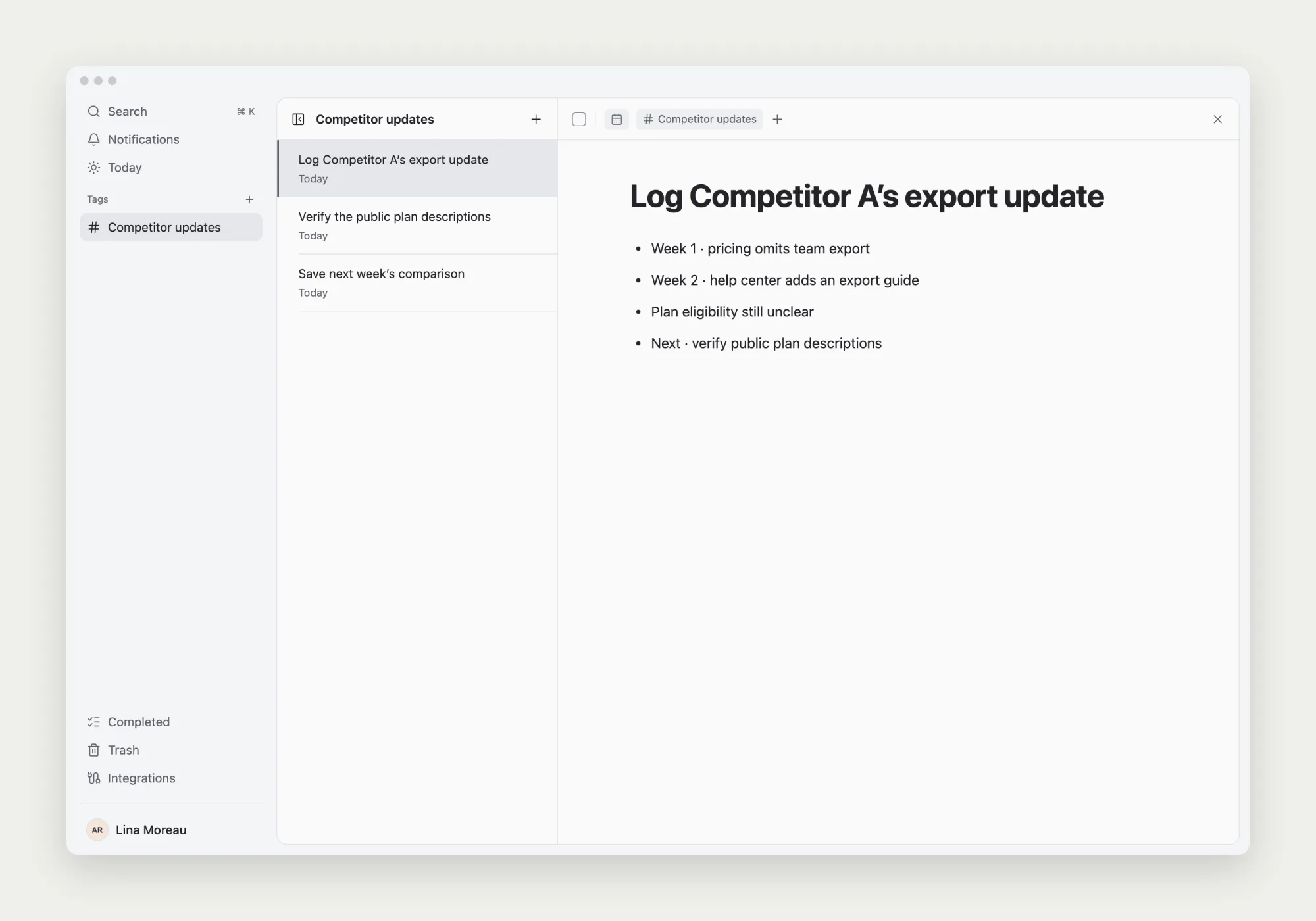
In TodoNote, group changes with a competitor-updates tag. Put evidence in the task note and schedule the plan check as a dated follow-up.
When the pricing page becomes clearer, add the verification result. Link the record from any product decision that used the finding.
Copy the template
Compare two weeks of public evidence and document what changed, where you saw it, and what to verify.
If a finding changes, append the new date and source. Keeping the original observation makes it possible to explain why your conclusion changed.
Competitor, region, and sign-in state:
Date observed:
Location and source link:
Previous observation:
Current observation:
Possible impact:
Verification method, owner, and date:
Result and related decision:For a related workflow, see Competitive Analysis Template: Test the Same Feature Across Three Tools.