A knowledge note can begin with something you do not understand yet. Capture “Understand LLM pretraining” as a task, then write your sources, explanations and open questions inside it as you investigate. When this exploration is finished, check off the task. Its body remains as a note you can return to. Giving curiosity a task gives the future note a concrete starting point.
Today a reference to LLM pretraining catches your attention. Tomorrow it might be an SSTable. You have an interest, but no time to follow it immediately. A few days later you may remember the term and have forgotten what made it interesting.
Keep the initial interest
“Explore SSTables” is enough to capture the impulse. Add the question if you have one: “How do updates work once data is written into an SSTable?” Save the page that prompted it. You now have somewhere to begin when you return.
You can leave the task unscheduled until you want to work on it. There is no need to give every interest a deadline or turn it into a syllabus. Interests can also fade; removing a task is a reasonable way to keep the list useful.
Find one thing to understand this time
LLM pretraining is a concrete topic, yet it opens into data, architecture, objectives and compute. Follow the part that draws you in. For this exploration, that could be: why is next-token prediction a training task, and where does the correct target come from?
That question gives this session a manageable scope. Read, investigate or ask an AI follow-up questions around it. Keep interesting branches in the body, and make a separate task when you actually want to pursue one.
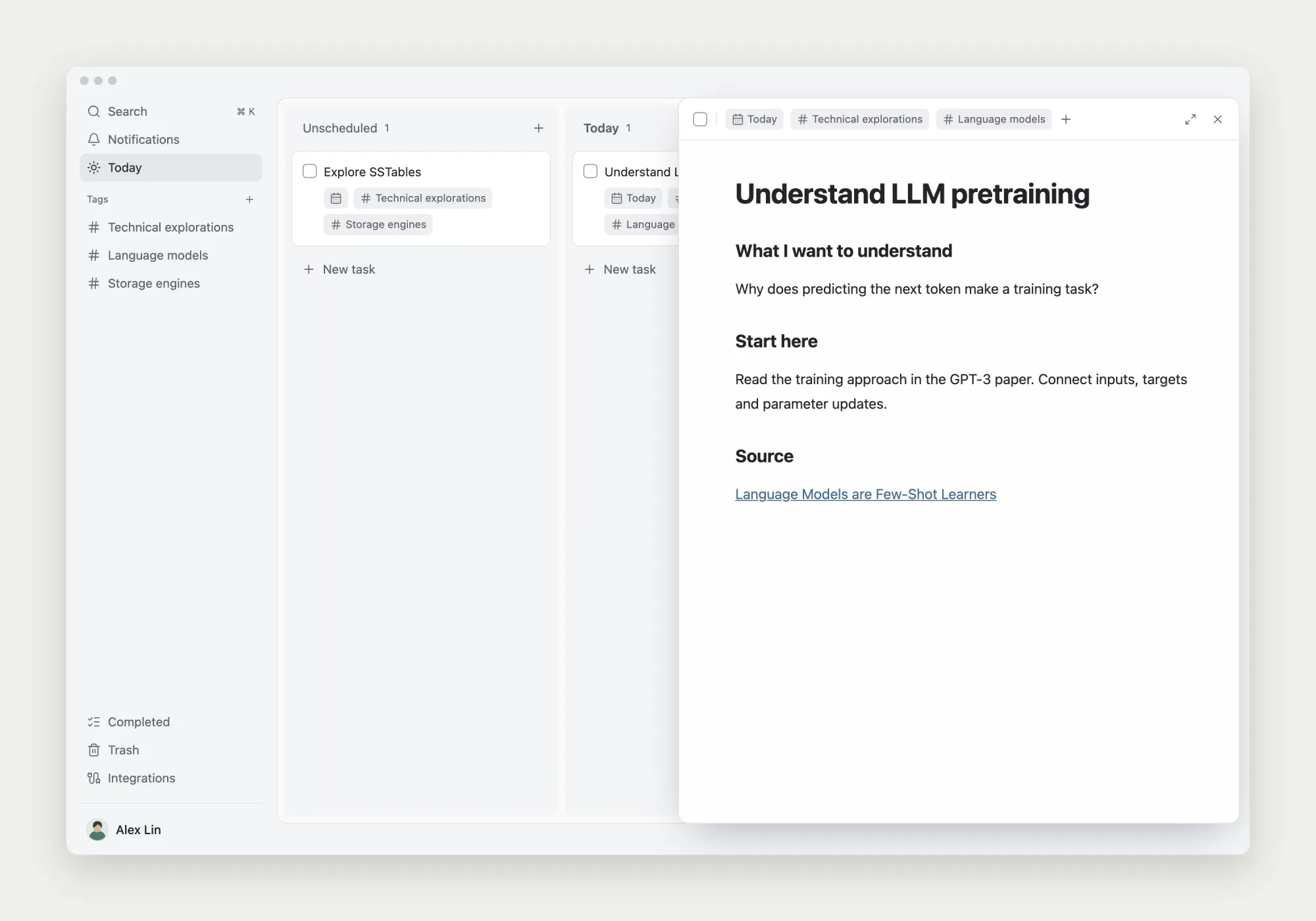
Write your explanation in the task
For an autoregressive model such as GPT-3, the context is used to predict the next token, with the observed token supplying the target. The GPT-3 paper is one source for this exploration. Your note can point back to the relevant material.
Then explain the missing step in your own words. Take a short sentence, mark the context and the token that follows, and connect input, prediction, loss and parameter update. The useful part of the card is the reasoning you can reconstruct later.
Keep sources beside the explanation they support. Name unresolved points precisely. If you use AI to challenge an explanation or suggest an example, check technical claims against the paper or implementation documentation before treating them as settled.
Early notes can be rough. At the end of the session, gather what answered your question, the example that helped and the next uncertainty. The task now contains a note shaped by your investigation.
When can you check it off?
Finish when you can explain the point you set out to investigate. Completing this pretraining task can mean understanding the basic training process. Data mixtures, optimizers and distributed training can each become a later exploration.
Try closing the source and explaining the step that originally puzzled you. Repair the gaps you still care about; save new branches as future questions. This gives the completed task a clear result and a clear boundary.
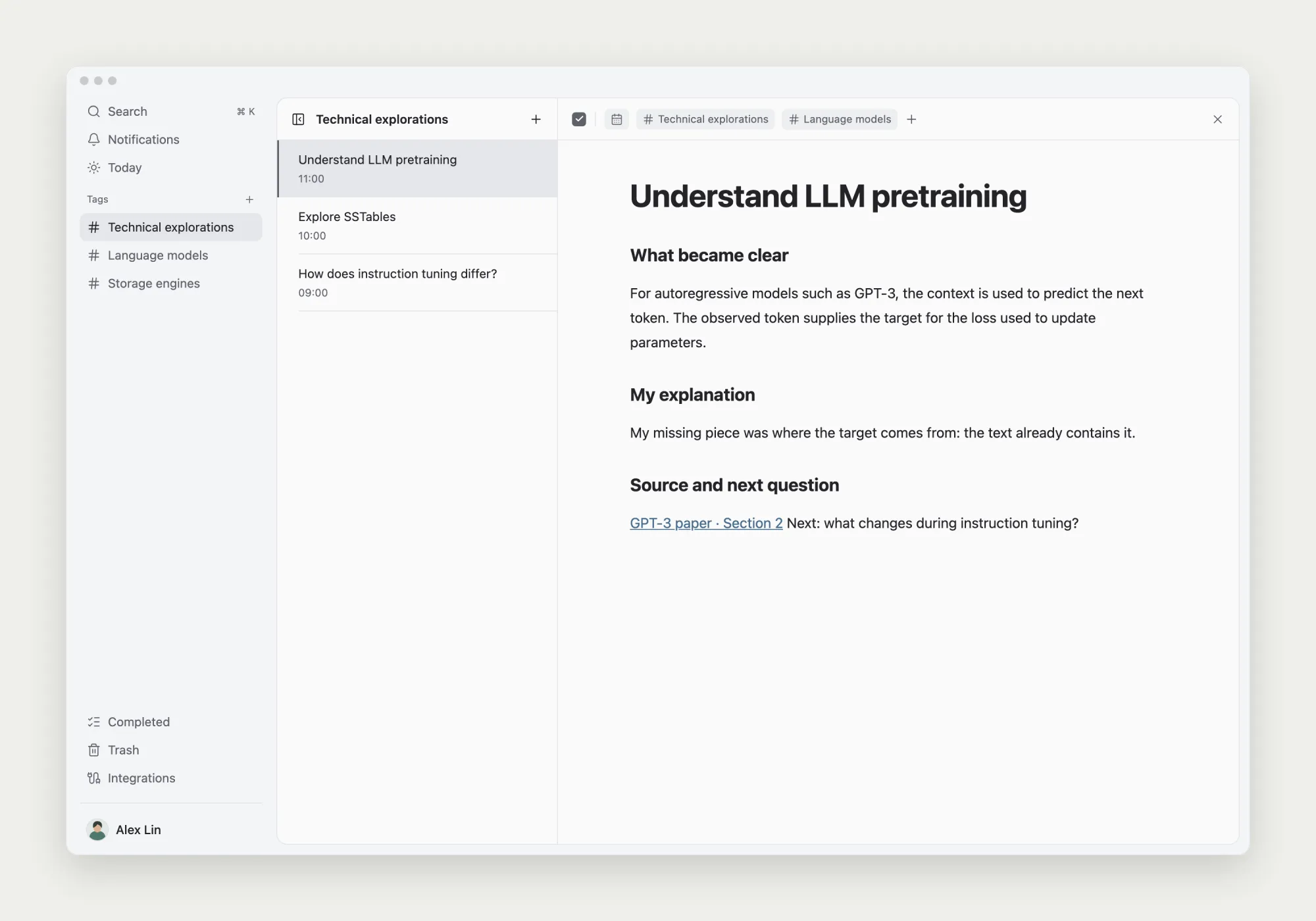
Let connections grow from the notes
In TodoNote, each task has its own body for notes. After completion, you can return through Done, tags or title search. A Language models tag can gather pretraining notes, while Storage engines gathers SSTable notes. Technical explorations can collect both.
Later, an instruction-tuning note can link to the pretraining task with a sentence explaining the relationship: “Continue here to compare the objective and the form of the data.” That explanation gives the link a reason to exist.
Split an idea into its own card when it can answer a question independently or be useful elsewhere. Keep a link back to the original investigation. You can make that decision after the idea has developed.
Tomorrow, follow the SSTable question
Create “Explore SSTables” and record the part you want to understand: how are updates and deletions represented? The LevelDB implementation notes offer a concrete place to begin reading and building your own explanation.
These two explorations need not connect or belong to a planned curriculum. Each starts from a specific interest and leaves its question, sources and your understanding available for the next encounter.
Capture curiosity while it is fresh. When you return, let the task hold the investigation. At the start it says what you want to understand; at the end it holds what you have understood.