My daily English practice starts with one question from AI. I answer in four or five sentences, ask for feedback, and save three things: the question, what I learned, and a reference answer. In TodoNote, each daily task has a date in its title and the same Daily English tag.
The small scope makes the next action clear. I do not have to design a lesson every time I sit down. A few sentences give the AI something concrete to review, and the question gives the expressions I save a context.
Give each session its own date
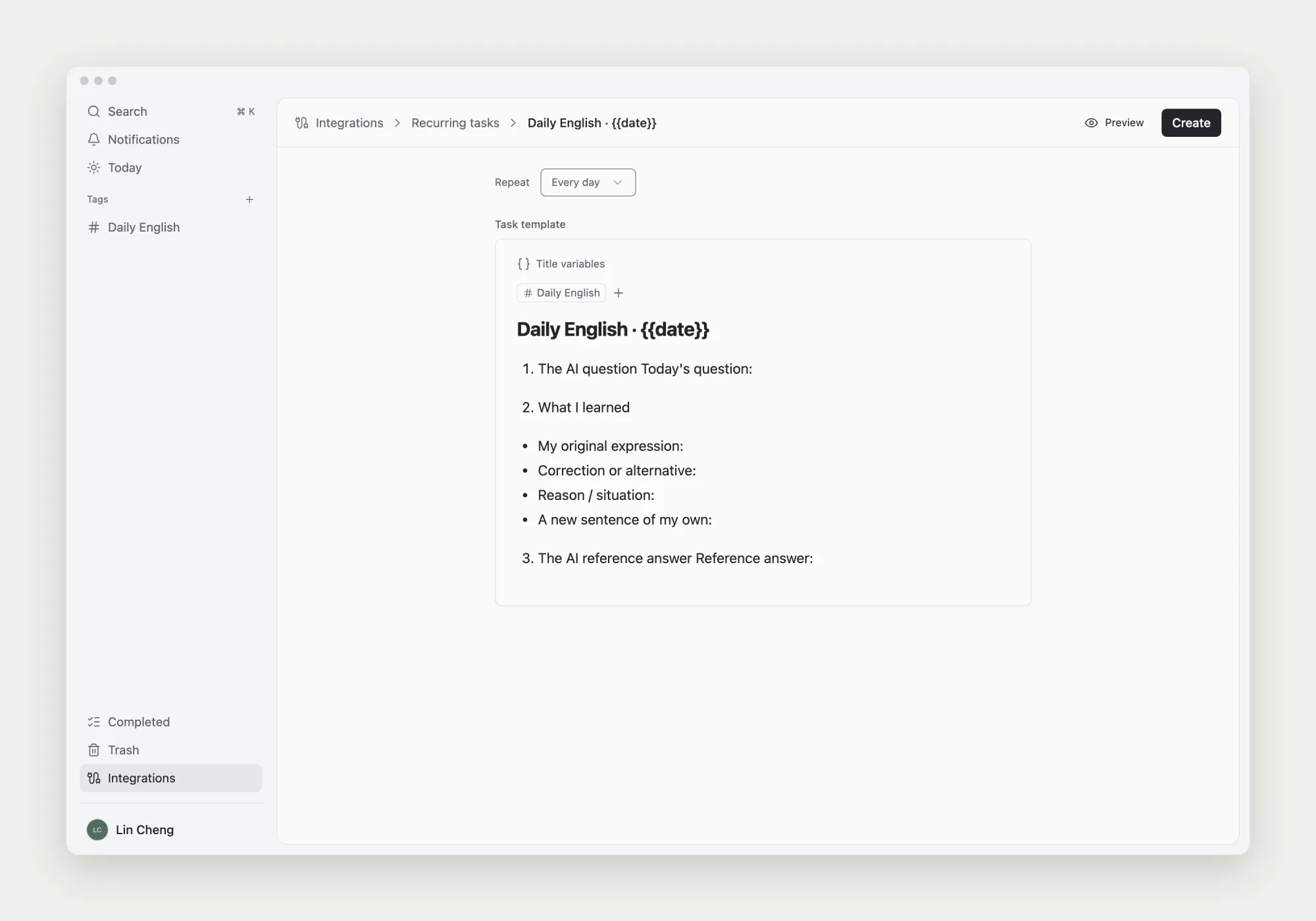
The recurring title can be “Daily English · {{date}}”, with a daily schedule. The date variable distinguishes each generated task, such as “Daily English · 2026-11-10”. I put the three note headings in the template so each session starts with the same useful structure.
The format repeats; the answers belong to individual sessions. If I miss a day, I keep the record honest and continue with the next practice. The dates then describe what actually happened rather than a reconstructed streak.
Answer before asking for a rewrite
The topic can be an ordinary experience, a work situation, or an opinion. I write my own response first. That makes it easier to see whether I lacked a word, struggled with a sentence, or simply did not know a particular expression.
A reusable prompt is: “Ask me an everyday English question and wait for my four- or five-sentence answer. Then correct grammar and word choice, explain more natural alternatives, distinguish necessary corrections from optional rewrites, and finish with a reference answer.”
For “How do you relax after a busy day?”, an initial response might be: “After a busy day, I usually listen music. It makes me feel relaxed. I am looking forward to spend some quiet time at home. Then I feel ready for the next day.” There is already enough material for specific feedback.
Save corrections and alternatives differently
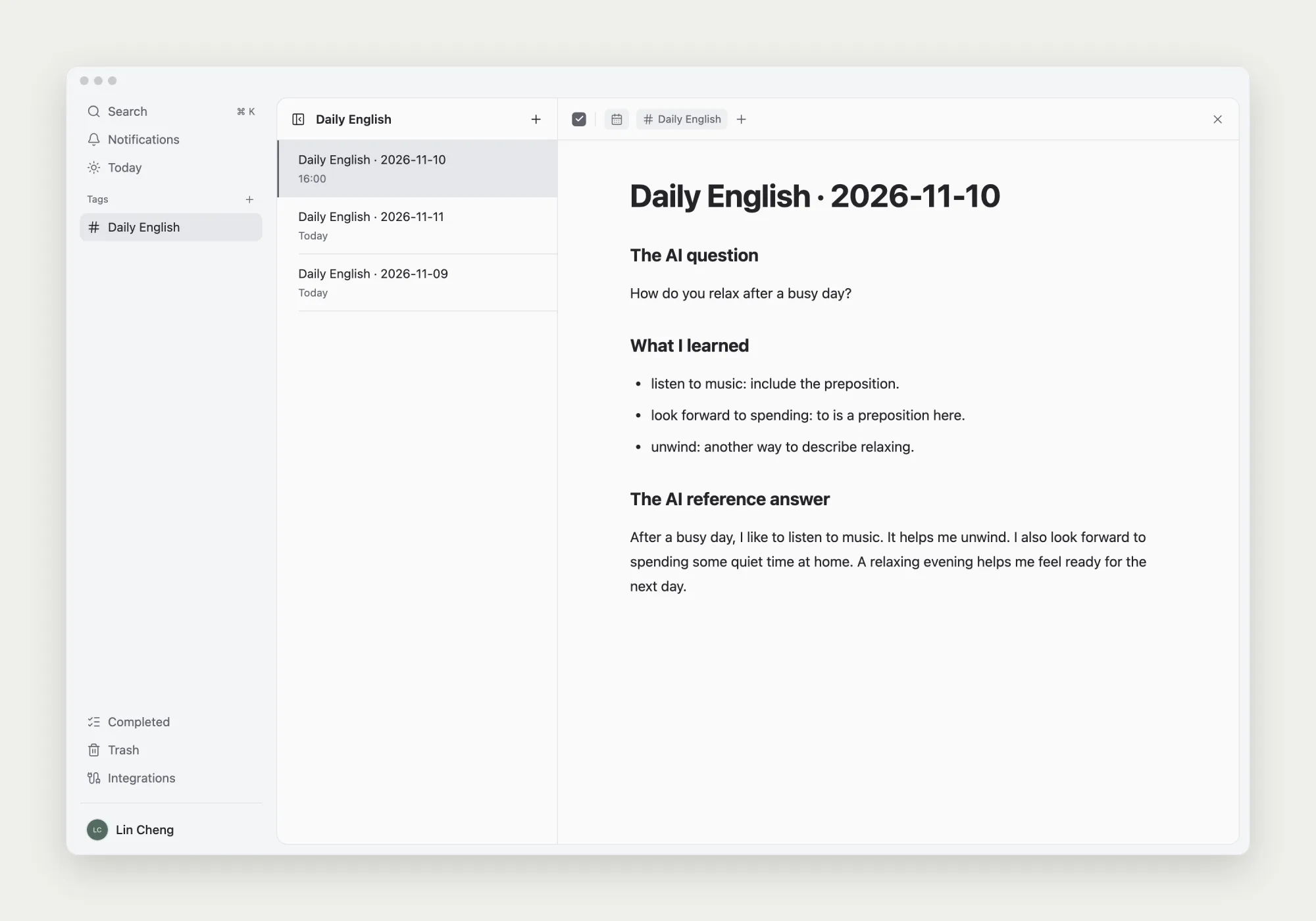
Two useful corrections are “listen to music” and “look forward to spending”. For the second pattern, the verb after “look forward to” takes the -ing form; the Cambridge grammar reference explains why.
“It makes me feel relaxed” is a usable sentence. “It helps me unwind” is another option, rather than proof that the original was wrong. Labeling that distinction keeps the note from turning every stylistic suggestion into a rule.
Keep three parts, with the original meaning intact
The first part preserves the question. The second collects a few expressions, their corrections, and when to use them. The third holds the reference answer. The full original response can stay in the AI conversation; the note keeps the parts I want to reuse.
I ask for a reference answer close to my meaning and length. If it introduces language I cannot yet use, I request a simpler version. Writing a fresh sentence with one of the expressions is a practical way to try it myself.
A note structure to reuse
1. The AI question
Today's question:

2. What I learned
- My original expression:
- Correction or alternative:
- Reason / situation:
- A new sentence of my own:

3. The AI reference answer
Reference answer:Use the tag to return to earlier questions
Completing the task keeps its note. The Daily English tag gathers dated sessions together, so I can choose an older question, answer it again, and compare my new response with what I saved before.
Each session leaves a small, specific piece of practice. One useful expression is enough to give the next session something to build on. See the recurring-task guide for setup, or the self-study practice plan for a broader learning goal.