A useful requirement change log records the original agreement, the requested difference, its reason, and its impact on scope, dates, and acceptance. Add who confirmed which parts and when, including anything deferred or rejected. Update the work after the decision while keeping the earlier agreement available for comparison.
Nina coordinates an event registration page planned for Nov 6. The original scope collects registrations and shows a success message. On Nov 2, the event lead asks for a limit of 50 places and a waiting list. Nina assesses these as two requirements before changing the delivery plan.
Preserve the original agreement before adding the request
Date or version the existing requirement and retain its confirmation source. This baseline has no capacity enforcement, full state, or waiting-list notifications. Put the new request in its own record so the earlier agreement remains visible.
Give the request a short reference such as CHG-01. Record the requester, date, original wording or conversation source, and the problem it should solve. Distinguish added scope, clarification, and defects before deciding what belongs in the current delivery.
Check behavior and dependencies, as well as the visible interface
A 50-person limit needs rules for counting places, duplicate submissions, the full state, and concurrent requests. A waiting list adds collection, notification, and handling rules. Assess those behaviors before treating the change as one extra form field.
APM’s explanation of change control describes recording, evaluating, and deciding on changes before updating an approved plan. Nina uses that sequence to check implementation, copy, and acceptance work, with unresolved rules kept visible.
| Item | Original scope | Decision on Nov 2 |
|---|---|---|
| Successful registration | Show confirmation after submission | Keep existing behavior |
| Capacity limit | Not included | Add 50-place limit and full message |
| Waiting list | Not included | Defer; assess handling rules separately |
Record approved, deferred, and unresolved parts separately
On Nov 2, the event lead confirms the 50-place limit and full message for this delivery. The waiting list is deferred with its open questions retained. The record points to the confirmation and affected requirement version. Nov 6 remains the target, with a Nov 4 progress check to decide whether the date needs changing.
In TodoNote, Nina saves the confirmation in a task note and writes its current status explicitly. The authorized project decision-maker makes the decision; the note records it and supports later planning. A requested feature becomes a delivery commitment only after its scope is confirmed.
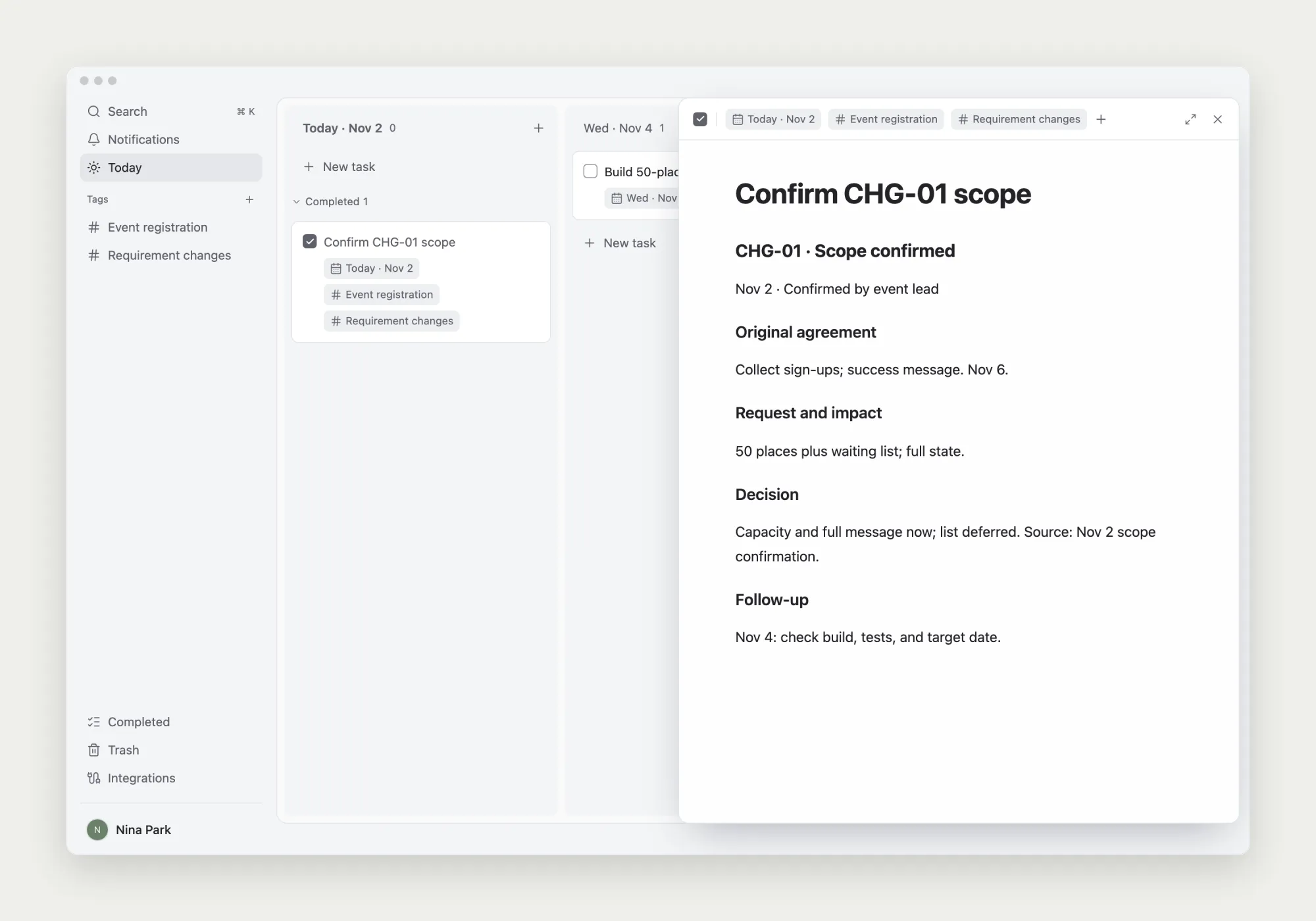
A reusable requirement change log template
Match the detail to the impact. One request may contain both approved and deferred parts, so make the current scope clear for the person doing the work.
Change reference / requested on / requester:
Original agreement / version / source:
Requested addition or modification:
Reason / problem to solve:

Impact on scope / date / effort / risk:
Rules and acceptance checks to confirm:
Decision (approved / deferred / rejected):
Decision-maker / date / source:

Current requirement / superseded agreement:
Follow-up tasks / responsible contact:
Next check / unresolved questions:
Implementation and acceptance result / evidence:Update tasks and acceptance criteria after confirmation
Nina creates work for capacity enforcement, the full message, and boundary and concurrency checks. Each task refers to CHG-01 in its note and gets the “Event registration” tag. Waiting-list rules stay unscheduled until assessed and confirmed.
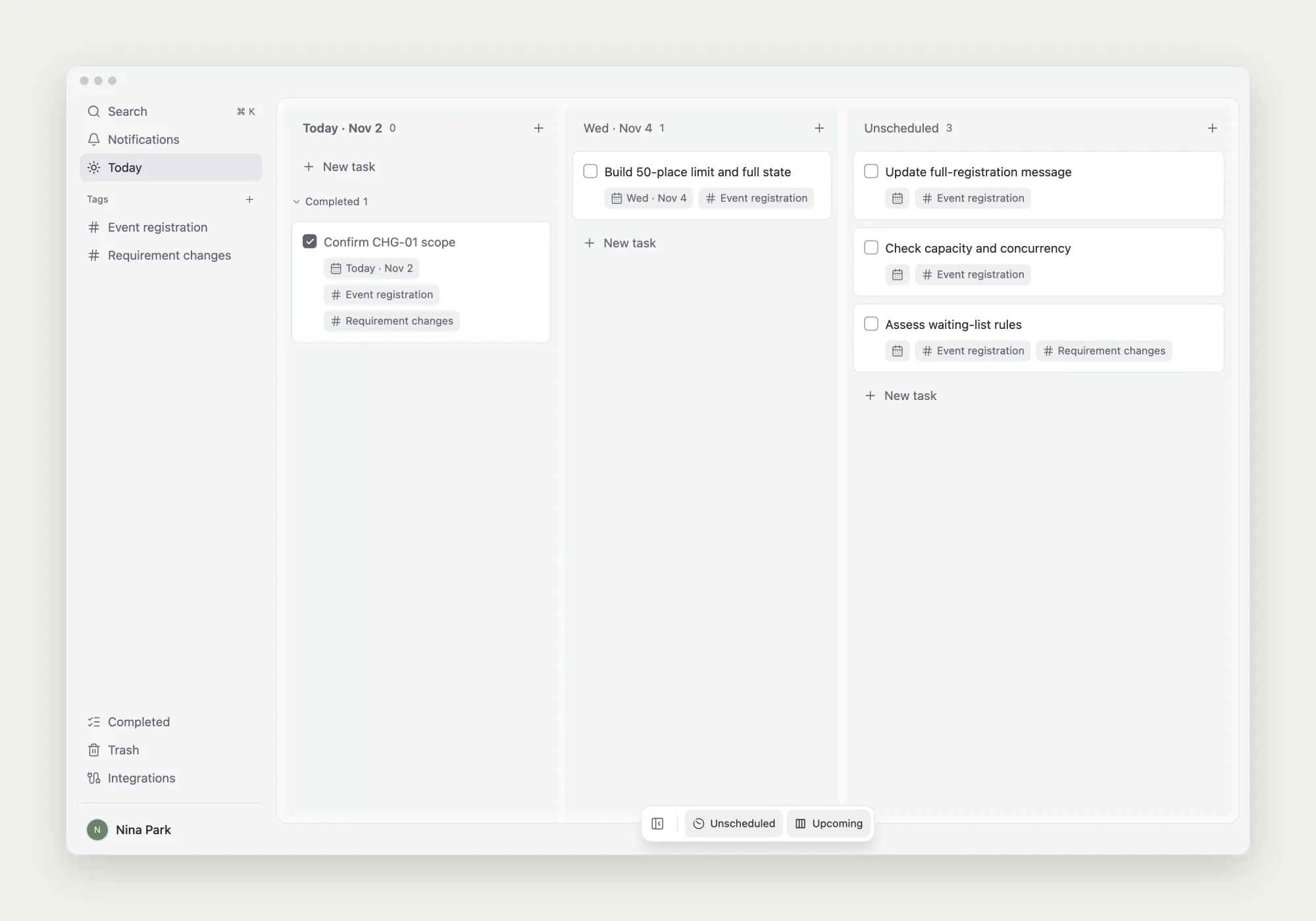
The scope confirmation task is complete; implementation and acceptance remain open. Keep the original successful-submission check and add capacity and full-state tests. This preserves the existing behavior alongside the new requirement.
At the Nov 4 check, review implementation evidence, unresolved rules, and remaining work. Record any agreed date change rather than silently replacing the earlier commitment. After acceptance, write back the result and evidence location; give later changes their own references.
Use a decision record when the trade-offs need explanation, and task breakdown for the resulting work. The change log keeps the current scope and its origin available for everyone who needs to check them.