A weighted decision matrix compares options against the same criteria. Give each criterion a weight, score each option on a consistent scale, multiply score by weight, and add the results. First screen out options that fail non-negotiable requirements and make the weights total 100%. Then check evidence and sensitivity: the highest score is a result under stated assumptions, not an automatic decision.
Two vendors look convincing, and the discussion keeps returning to “I prefer this one.” A matrix opens that preference up: what matters, what supports each score, and would a different assumption change the choice?
Screen requirements before trading off strengths
Priya Shah is comparing three software vendors for a small team. Each must stay within an annual total-cost limit of $4,000 and export the data the team needs. An option failing either requirement is removed before scoring. Excellent support cannot compensate for a missing mandatory export. The amount is a boundary for this example, not a recommended budget.
Among the remaining options, compare cost, functional fit, and support. Avoid giving price, total cost, and affordability three separate weights for essentially the same benefit. Keep criteria distinct enough that each adds a real consideration.
Define the scores before looking at totals
Use one 1–5 scale where higher is always better: 1 means substantially below need, 3 meets the basic requirement, and 5 meets the preferred target; 2 and 4 sit between adjacent anchors. A lower cost must receive a higher cost score. Do not add raw prices to feature scores.
Give each row checkable anchors, such as “fit 5: all five key workflows work” or “support 5: a first response promised within one working hour.” Distinguish a vendor promise, an observed result, and an unknown. An unsupported high score remains provisional until its evidence is checked.
Multiply each score by its weight
Priya agrees weights of 40% cost, 35% fit, and 25% support before totaling the options. These weights express this team’s tradeoff. Use the same scale for every vendor, and keep quotes, demonstration notes, or service terms beside the scores.
| Criterion | Weight | A | B | C |
|---|---|---|---|---|
| Cost | 40% | 5 | 3 | 4 |
| Functional fit | 35% | 3 | 4 | 4 |
| Support | 25% | 2 | 5 | 3 |
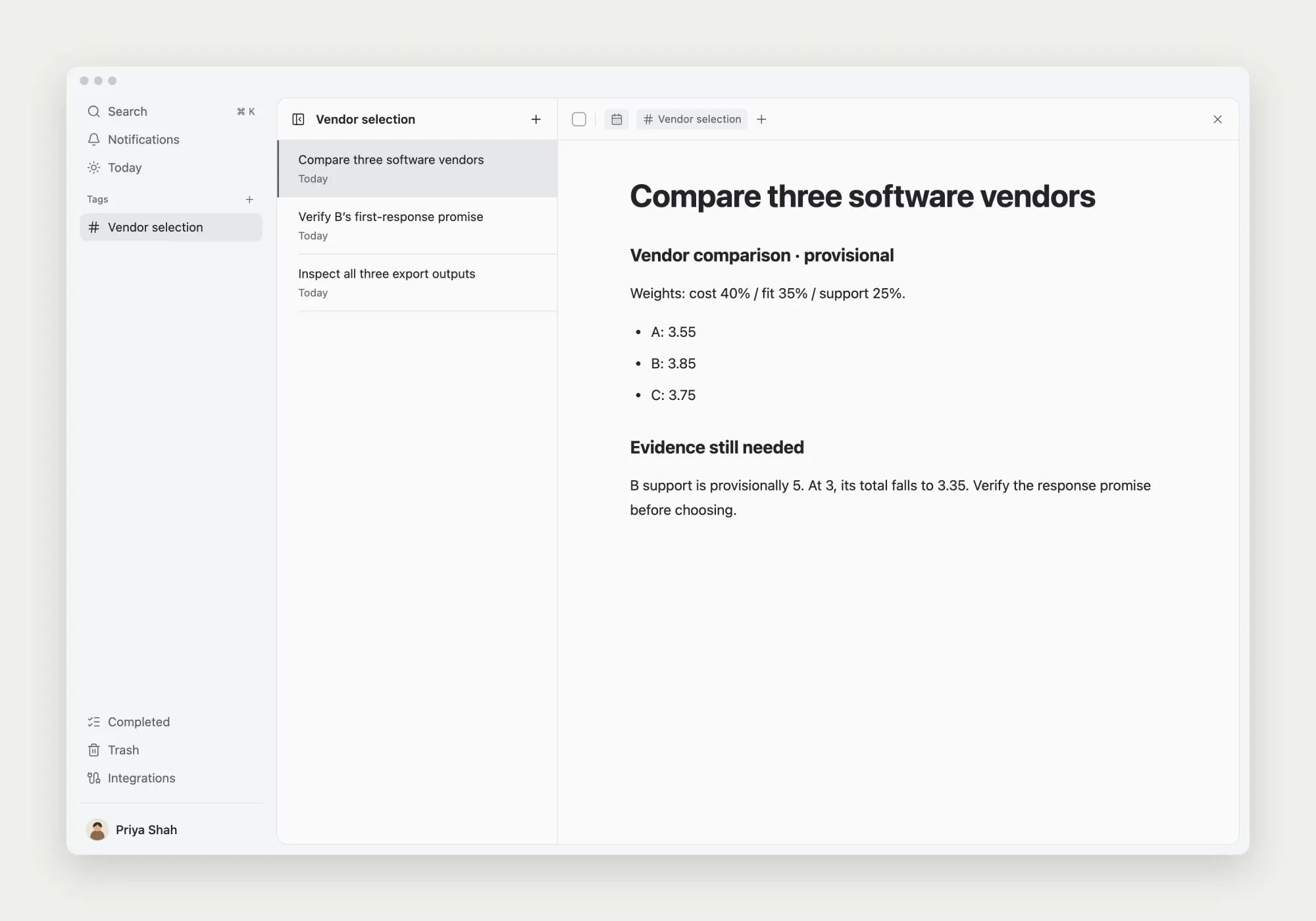
| Weighted total | 100% | 3.55 | 3.85 | 3.75 |
B scores 3 × 0.40 + 4 × 0.35 + 5 × 0.25 = 3.85. A scores 3.55 and C scores 3.75. B leads under these weights and provisional ratings. A margin of 0.10 is a reason to inspect the inputs, not proof that the recommendation is robust.
Change a premise and check the result
If cost becomes more important, try 55% cost, 30% fit, and 15% support, still totaling 100%. The new totals are A = 3.95, B = 3.60, and C = 3.85. A now leads. Discuss the budget tradeoff before choosing rather than adjusting weights to preserve a favorite.
Return to the original weights. B’s support score of 5 comes from a promise that has not been tested. If checking it reduces that score to 3, B falls to 3.35, below C’s 3.75. Validating that promise is more useful than adding another decimal place to the total.
A decision-matrix preparation template
Decision / latest decision date:
Options:
Non-negotiable requirements / evidence:
Excluded options / reasons:

Criteria / definitions:
Score scale / meaning of a high score:
Weights / total 100%:
Each score / source / date checked:
Unknowns / provisional assumptions:
Weighted totals:

Result with changed weights:
Result with a changed critical score:
Evidence to validate / next action:
Final choice / reason / revisit conditions:Connect the calculation to the next check
In TodoNote, Priya keeps the scoring evidence, totals, and sensitivity check in the vendor-selection task note. She creates separate tasks to verify B’s first-response promise and inspect all three export outputs. The shared tag keeps them together; the choice stays open while those checks remain unfinished. Scores are recorded manually in the note; a spreadsheet can handle larger calculations.
Retain the original weights and scoring date. Append a dated revision when new evidence changes a rating, then recalculate. This preserves why an earlier recommendation looked reasonable instead of leaving only the latest number.
Use the matrix to support the discussion
A short checklist may be enough when one option clearly satisfies the need. A matrix helps when several criteria pull in different directions. If one unknown determines the entire ranking, resolve it before treating the score as a recommendation.
ASQ’s decision-matrix guide describes comparing options with criteria, weights, and ratings. After comparing, use a decision log to preserve the final choice. For developing the supporting recommendation, see turning research notes into a decision brief.