A useful Black Friday shopping list records the need, budget, candidates, comparison evidence, decision, and after-purchase deadlines. Define the problem first, then check the exact model, total price, and return conditions. Keep “interesting” separate from “decided to buy” so the list supports a choice instead of collecting more offers.
A countdown can feel more concrete than the reason for a purchase. Google's holiday shopping guide discusses how discount timing differs by category. For your own list, start with your need and the terms you can verify on the actual offer.
Write one reason before adding candidates
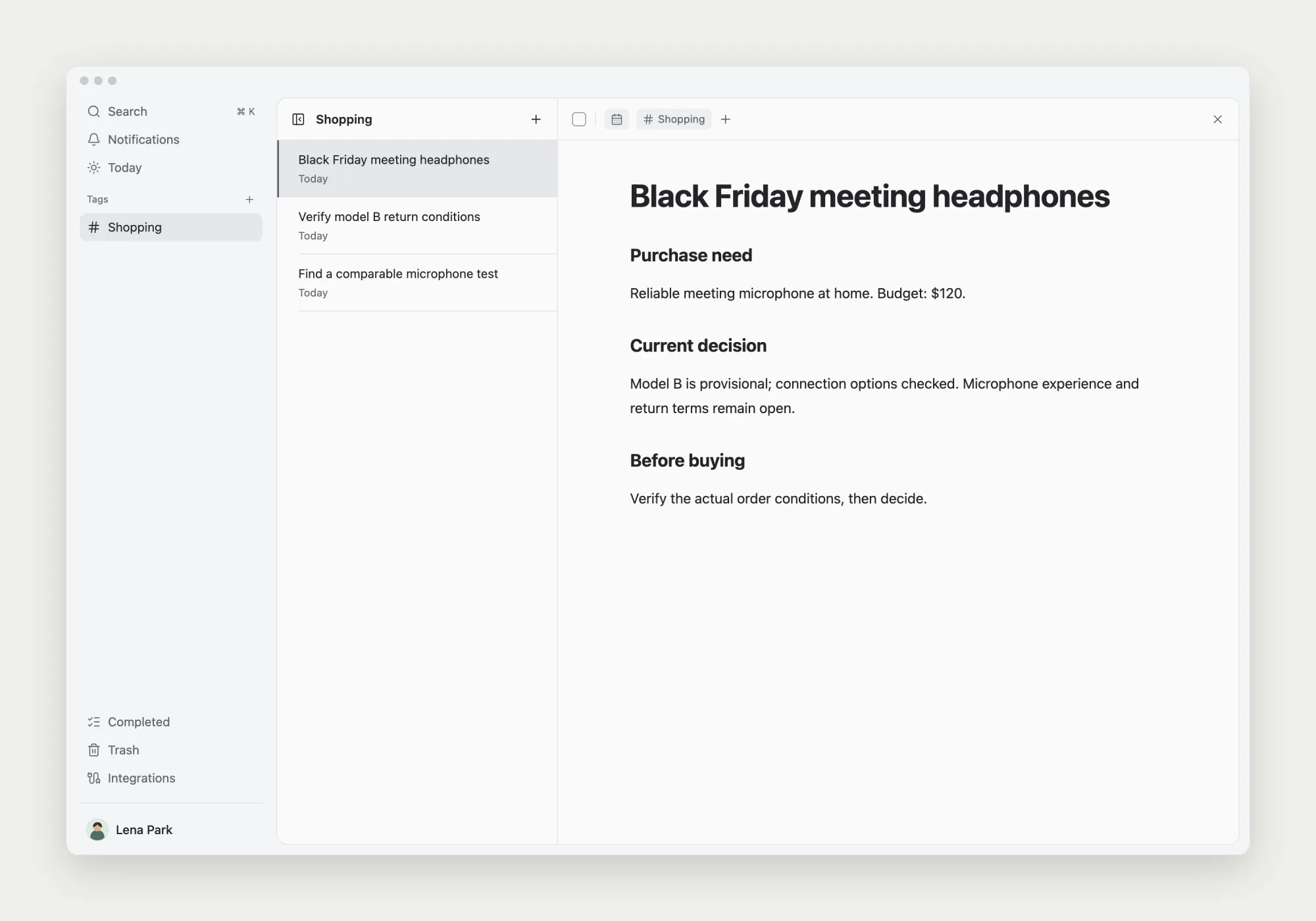
Lena needs headphones for remote meetings because her current microphone is unreliable. Her requirement is clear speech at home, with a budget of $120. Noise cancellation, looks, and brand can be compared, but they do not replace the main job the purchase needs to do.
Begin with no more than three candidates. Record the exact model, seller, date checked, and conditions behind the displayed price. Memberships, bundles, and required extra purchases affect the total. The largest number on a promotion page is not necessarily the amount you will pay.
Leave uncertain claims uncertain
Specifications, hands-on experience, and marketing language are different evidence. Lena checks connection options in the official documentation but still needs a microphone test in a similar environment. “Best call quality” remains unverified until a useful source supports it.
| Situation | Response | Record to keep |
|---|---|---|
| A discount without a clear need | Defer the decision | Problem with the current item |
| Specifications fit, experience is unknown | Find a comparable hands-on test | Model, source, and test conditions |
| Ordered but not tested | Schedule delivery checks | Actual order terms and test result |
A buying decision still leaves follow-up work
She provisionally chooses model B but waits to confirm its return conditions. After ordering, she keeps the receipt and actual deadline and schedules a delivery test. Use the rules for that seller and order rather than assuming every purchase has the same return window.
A template you can copy
Problem the purchase should solve:
Why the current item is insufficient:
Budget and option not to buy:

Candidate models and sellers:
Checking date and source links:
Total cost and discount conditions:
Verified specifications:
Uncertain experience or limitations:

Choice or reason to defer:
Order and receipt location:
Actual return terms and deadline:
Checks to perform on delivery:
Did it solve the original problem?Keep the comparison with its task
In TodoNote, one considered purchase can be a task with the comparison and order references in its note. Subtasks can cover checking, testing, or a return follow-up. TodoNote does not automatically compare prices or verify seller promises; check important terms at their source.
After use, record whether the item solved the original problem. That is more useful for the next purchase than the discount percentage alone. If no candidate meets the need, “defer” is a valid decision with a reason worth keeping.
See the tasks and subtasks guide for the controls, and Weighted Decision Matrix: Template and Worked Example for the next step.
Background reading: original source.