RICE compares reach, impact, confidence and effort to help order candidate features. MoSCoW identifies Must, Should, Could and Won't-have-this-time scope. Use RICE to compare opportunities and MoSCoW to negotiate a delivery commitment, or establish scope before ranking optional work.
A score can structure discussion, but it cannot decide which promise is essential. First identify whether the decision concerns relative value or the minimum usable release.
Make RICE inputs comparable
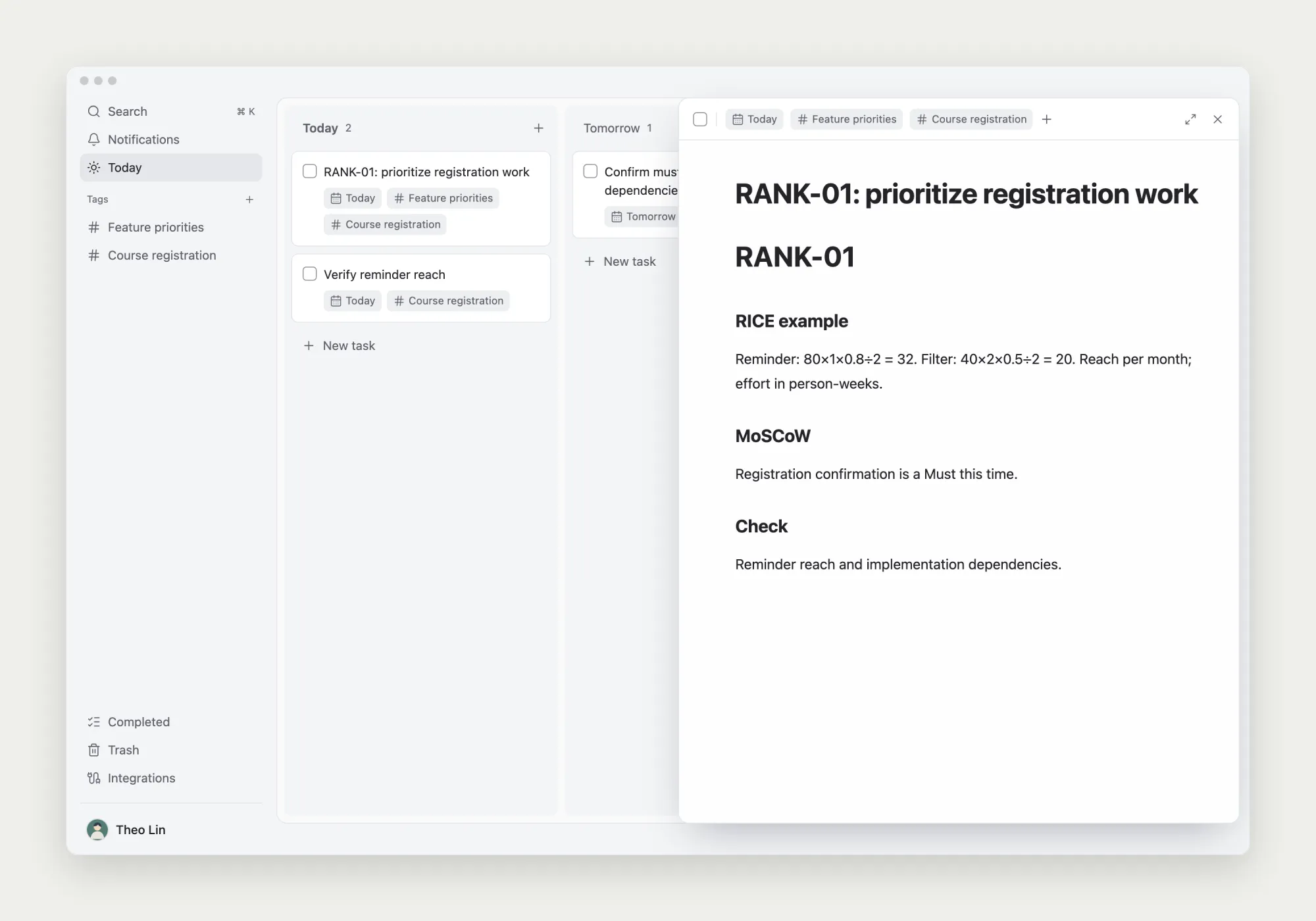
The RICE score is reach multiplied by impact and confidence, divided by effort. Use the same reach period and effort unit across candidates; represent confidence as a decimal. Keep evidence beside each input.
RANK-01 compares reminders at 80×1×0.8÷2 = 32 with filtering at 40×2×0.5÷2 = 20. Reach uses the same month and effort uses person-weeks. Without those shared units, the scores would be misleading.
| Feature | RICE example or treatment | MoSCoW for this release |
|---|---|---|
| Reminder | 32; reach still needs checking | Should; a manual alternative exists |
| Course filter | 20; impact remains uncertain | Could; can wait |
| Registration confirmation | Check essential release constraints first | Must; required to complete registration |
| Theme skins | Insufficient evidence to score | Won't this time |
Explain why a Must cannot be omitted
A Must needs a reason why the release cannot achieve its goal without it and why no acceptable workaround exists. A Should matters but has a temporary alternative; a Could fits if capacity permits. Won't this time does not mean never.
If everything is a Must, return to the minimum usable outcome, constraints and dependencies. Merely relabeling the list will not create the necessary trade-offs.
Use disagreement to find missing evidence
A higher-scoring reminder can still depend on unavailable inputs. Changed effort or reach can reverse the ranking. Check assumptions that materially affect the decision and leave unsupported values unknown until a small test supplies evidence.
In TodoNote, keep candidates as tasks and retain inputs, sources and must-have reasons in their notes. Subtasks can cover evidence and dependencies. Record calculations or link a spreadsheet; tags organize work without automatically calculating priorities.
Copyable template
Decision to support:
Release period and goal:
Candidate feature:
Reach and time period:
Impact scale:
Confidence and evidence:
Effort unit and estimate:
RICE calculation:
MoSCoW category:
Specific must-have reason:
Acceptable workaround:
Dependencies and unknowns:
Assumption that could change order:
Next evidence-gathering action:
Decision and reconsideration trigger:Background sources: Intercom · Agile Business Consortium
Related reading: Weighted Decision Matrix: Template and Worked Example · How to keep a requirement change log that stays useful during delivery